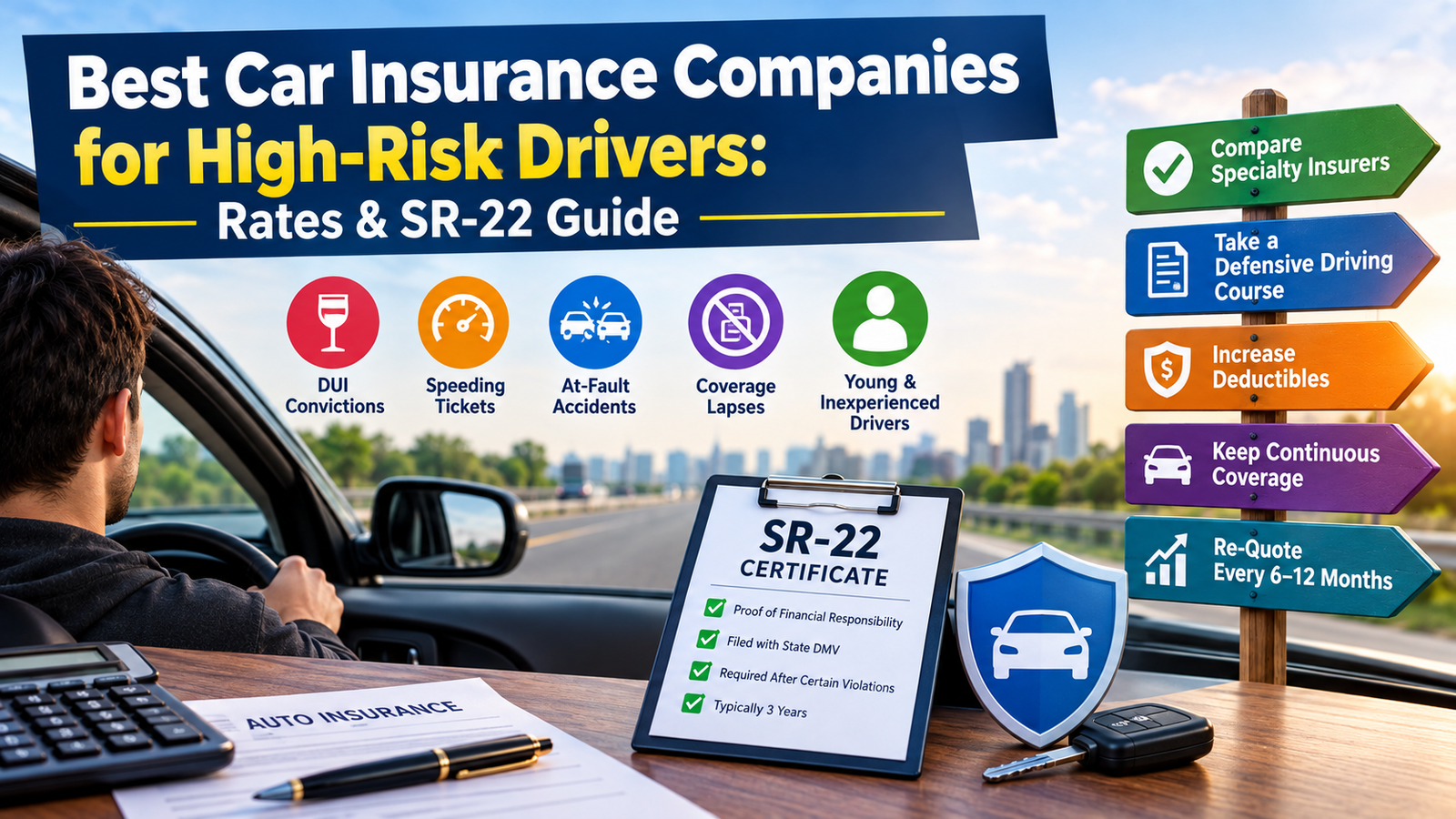

Being categorized as a “high-risk driver” can double or even triple your auto insurance premium overnight—whether triggered by a DUI conviction, a series of speeding tickets, an at-fault crash, a coverage lapse, or simply being an inexperienced young driver without a track record.
Fortunately, a high-risk label does not mean you cannot get insured, nor does it lock you into elevated rates forever. This guide explains which insurance carriers specialize in high-risk coverage, how SR-22 certificates operate, and actionable steps to transition back into affordable, standard-rate tiers as quickly as possible.
What Makes a Driver High-Risk in an Insurer’s Eyes?
Carriers define underwriting risk through your motor vehicle record, accident claim history, credit-based insurance score (where state law permits), age, and continuous insurance history. A single at-fault collision might bump premiums by 20% to 40%, whereas reckless driving, DUIs, or several moving violations within three years can push you into non-standard specialty markets where standard carriers refuse coverage entirely.
Lapses in continuous insurance coverage lasting more than a few weeks also trigger high-risk flags, as insurers view continuous coverage as a primary indicator of financial responsibility. Additionally, drivers under 25 face higher baseline rates due to actuarial statistics reflecting higher accident frequency in younger demographics—rates that decrease steadily as drivers mature with clean records.
Standard vs. Non-Standard (High-Risk) Insurance Companies
Household-name carriers focus on “preferred” and “standard” risk profiles, either turning down high-risk motorists or quoting prohibitive rates. Non-standard specialty carriers exist specifically to insure drivers with prior violations, recent suspensions, or coverage lapses. While their rates exceed standard pricing, they are routinely much cheaper than standard carriers’ punitive high-risk tiers.
| Carrier Category | Typical Driver Profile | Rate Behavior & Pricing |
|---|---|---|
| Standard / Preferred Insurers | Clean driving records, solid credit history | Lowest rates for qualifying motorists |
| Non-Standard Specialty Insurers | DUIs, SR-22 requirements, multiple tickets | Higher base rates, but competitive within high-risk pools |
| State Assigned Risk Pools | Drivers rejected across the private market | Highest premium costs; strict last-resort option |
Understanding SR-22 and FR-44 Certificate Filings
An SR-22 is not an insurance policy; it is an official certificate submitted by your insurer to the state department of motor vehicles confirming that you maintain mandatory minimum liability limits following a major infraction or suspension. Some states enforce an FR-44, which mandates higher liability limits than an SR-22.
While filing fees are minor ($15 to $50), premium increases stem from the underlying violation classification. States generally require keeping an SR-22 active for three consecutive years; any coverage cancellation during this term resets the clock and triggers immediate license suspension. Not all carriers file SR-22 certificates, so verify filing services before applying.
How Points and Driving Violations Age Off Your Record
Standard moving violations typically stay on state motor vehicle reports for 3 to 5 years, influencing insurance rates for a comparable timeframe. Serious infractions like DUIs can impact insurance pricing for 5 to 10 years. Because these surcharges decline as incidents age out of lookback windows, re-quoting policies at every renewal ensures you benefit from rate reductions as your record clears.
Actionable Steps to Lower a High-Risk Insurance Premium
- Complete a Defensive Driving Course: Completing a certified accident-prevention program earns an immediate 5% to 15% discount with many carriers.
- Increase Deductibles Strategically: Bumping collision and comprehensive deductibles to $1,000 reduces monthly premiums if you keep emergency savings to cover out-of-pocket costs.
- Participate in Telematics Programs: Enrolling in app-based tracking that proves safe driving habits can offset risk surcharges faster than waiting for years to pass.
- Bundle With Renters or Homeowners Policies: Multi-policy discounts apply across risk tiers, lowering total household insurance costs.
- Maintain Unbroken Continuous Coverage: Never allow policies to lapse, as even a 10-day coverage gap resets risk ratings with underwriters.
Re-Quoting Strategy: How Frequently to Shop Around
High-risk drivers benefit substantially from comparing quotes every 6 to 12 months rather than waiting years. As violations move further into the past, specialty insurers recalculate risk brackets. An independent broker representing multiple non-standard carriers can compare your record against several underwriting systems simultaneously, saving hours of manual paperwork.
What to Do If You Are Denied Coverage Everywhere
Every state operates an assigned risk plan guaranteeing auto insurance to licensed motorists unable to find private policies. While assigned risk premiums represent market-high rates, they serve as a necessary legal bridge to maintain continuous coverage while you build a clean record to qualify for private non-standard policies.
True Cost Breakdown: What High-Risk Motorists Actually Pay
Rate surcharges vary widely by state and violation severity. A single speeding ticket might increase rates by 15%, while a DUI often causes premiums to double or triple. Multiple moving violations compound exponentially in rating algorithms. While holding SR-22 insurance requires maintaining minimum state liability limits, carrying limits slightly higher than the state bare minimum provides vital financial protection against catastrophic liability lawsuits for modest extra premium costs.
How Insurers Monitor Your Driving Improvement
Insurers review motor vehicle reports at each renewal window. While carriers quickly add surcharges for new tickets, they rarely apply unprompted mid-term price drops for clean driving. You must proactively request a policy re-rate or collect competing quotes at renewal to capture lower rates as violations expire.
Selecting Appropriate Coverage Levels as a High-Risk Driver
Rather than slashing liability limits to lower premiums, adjust your comprehensive and collision deductibles instead. Raising deductibles protects your assets from third-party lawsuits while lowering monthly bills. If driving an older car with minimal cash value, dropping collision coverage entirely provides immediate savings without risking asset liability.
Avoiding Teaser Rates When Comparing Quotes
Certain non-standard providers advertise cheap initial quotes that spike dramatically at the first renewal once introductory discounts expire. Always request total 6-month or 12-month policy costs in writing, including installment processing fees, to ensure an accurate comparison.
Special Scenarios: Teens, Immigrants, and License Reinstatement
Young drivers under 25 face high statistical pricing that is best mitigated by remaining on a parent’s policy rather than purchasing a standalone plan, alongside claiming good-student discounts for high GPAs.
New immigrants lacking US driving records are often categorized as high risk due to unverified driving history; some specialized carriers accept formal letters of driving experience from foreign licensing agencies to offer standard tiers. Drivers reinstating suspended licenses must maintain uninterrupted SR-22 filings to prevent secondary suspensions.
Frequently Asked Questions (FAQs)
How long does a DUI conviction affect car insurance rates?
Generally between 5 and 10 years, depending on your state and the insurer’s underwriting lookback rules, though rate surcharges typically decline incrementally with each consecutive clean year.
Does insurance automatically get cheaper once the SR-22 requirement expires?
Not automatically. You must inform your insurer that your state mandate has ended or shop for a new policy, as carriers rarely remove high-risk surcharges without customer prompts.
Does credit history influence auto insurance rates?
Yes, in most states. Underwriters utilize credit-based insurance scores correlating credit patterns with claim frequency. A few states (such as California, Hawaii, and Massachusetts) prohibit using credit in auto pricing.
The Bottom Line
High-risk car insurance is expensive, but it represents a temporary stage for motorists committed to maintaining a clean driving record. Comparing non-standard specialty carriers, completing defensive driving courses, maintaining unbroken coverage, and re-shopping policies every 6 to 12 months as violations expire provides the fastest path back to preferred market pricing.