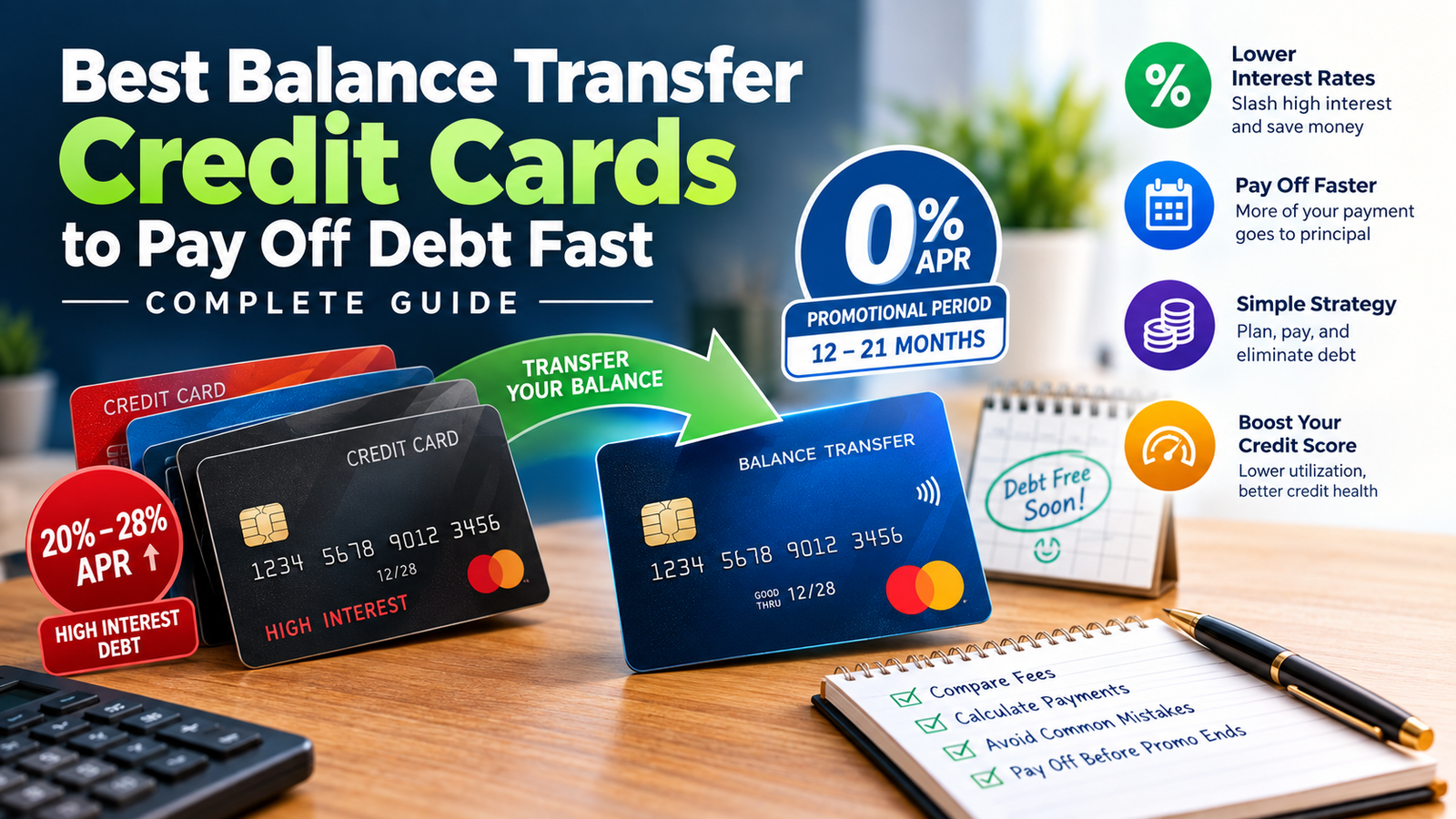

Carrying high-interest credit card balances is one of the most draining financial situations any household can navigate. A strategically chosen balance transfer card offers the fastest legal mechanism to slash that interest rate to zero for an extended promotional window.
This guide explains how balance transfers work in practice, how to determine whether the upfront transfer fee makes financial sense, and how to eliminate your debt completely before the promotional window closes rather than sliding back into high interest.
How a Balance Transfer Actually Works
A balance transfer moves outstanding debt from one or more existing cards over to a new account, typically one featuring a 0% introductory APR window lasting between 12 and 21 months depending on the bank.
Throughout this promotional period, 100% of your payments reduce the principal balance directly instead of being absorbed by interest charges. This drastically speeds up your debt payoff compared to leaving balances on cards charging 20% to 28% APR. Once the promotional term concludes, any remaining balance reverts to the card’s standard ongoing interest rate.
Understanding the Balance Transfer Fee
Most balance transfer cards charge a one-time fee—typically 3% to 5% of the total amount moved—which is added directly to your starting balance. On a $10,000 transfer, a 3% fee equals $300, while a 5% fee equals $500.
While that is a real upfront cost, it is almost always a fraction of the thousands in interest you would pay on an existing card over the same 12 to 18 months. A few cards occasionally waive the fee during promotional launches, though these offers typically feature shorter 0% repayment windows.
| Card Category | Typical 0% Window | Standard Transfer Fee | Best Suited For |
|---|---|---|---|
| Standard Balance Transfer Card | 12 to 18 months | 3% to 5% | General debt consolidation needs |
| Extended 0% APR Card | 18 to 21 months | 3% to 5% | Larger balances needing maximum payoff time |
| No-Fee Promotional Transfer | 12 to 15 months | 0% Fee | Smaller balances payable in under a year |
Calculating If a Balance Transfer Is Worth It
Always calculate the numbers before submitting an application. Determine the monthly interest you currently pay on your card, multiply that figure by the number of months required to clear the debt, and compare that total with the one-time 3% or 5% transfer fee.
In almost every scenario involving revolving credit carried for longer than four months, the transfer fee is significantly smaller than ongoing interest charges, making a transfer mathematically advantageous.
Establishing a Fixed Payoff Plan Before Transferring
The biggest pitfall with balance transfer offers is moving the balance without a firm mathematical payoff schedule. Divide your total transferred balance (including the fee) by the number of promotional months to determine your required fixed monthly payment.
Setting up automated monthly transfers for this exact amount prevents you from paying only the minimum, ensuring your balance drops to zero before standard APR rates apply.
Credit Score Requirements and Approval Guidelines
The most competitive 0% balance transfer cards—offering 18 to 21 months of zero interest and lower transfer fees—generally require credit scores of 690 or higher. Filers with fair credit can still secure transfer offers, though usually with shorter promotional windows. Use online soft-inquiry pre-qualification tools before submitting an application to evaluate your approval odds without affecting your score.
Common Mistakes That Ruin a Balance Transfer Strategy
- Using the Old Card for New Charges: Continuing to make purchases on the cleared card creates fresh debt on top of your transfer balance.
- Missing a Payment Due Date: Making even a single late payment can immediately void the 0% promotional APR, reverting your balance to standard or penalty rates.
- Ignoring Credit Limits: Assuming the new card will automatically grant a limit high enough to transfer 100% of your debt.
- Misjudging Your Payoff Timeline: Paying too slowly and leaving a substantial balance subject to high interest when the promotion ends.
- Applying for Multiple Cards at Once: Submitting multiple applications within days creates hard inquiries that temporarily reduce your credit score.
Rules on Transfers Between Cards From the Same Bank
Almost all major card issuers prohibit balance transfers between cards under their own brand. For example, you cannot move debt from one Chase card to another Chase card, or from one Citi card to another Citi card. You must select a card from a different financial institution to complete the transfer.
How a Balance Transfer Impacts Your Credit Score
Opening a new card produces a small, temporary dip in your score due to the credit inquiry and shortened average account age. However, the newly opened credit line expands your total available credit, which lowers your overall credit utilization ratio. As you steadily pay off the balance, your score typically climbs higher than it was when carrying high debt on maxed-out cards.
Alternative Debt Consolidation Options to Consider
A fixed-rate personal debt consolidation loan offers set monthly payments over 2 to 5 years, which suits borrowers who want structured payments without the risk of a promotional deadline expiring. Homeowners might consider a home equity line of credit (HELOC) for lower rates, though this ties unsecured credit card balances to your personal residence.
Consolidating Multiple Credit Cards Onto One Card
Many balance transfer cards permit you to combine balances from several different bank cards onto the new account, up to your approved credit limit. Merging several card balances into a single monthly due date simplifies your finances and eliminates the stress of managing multiple payment deadlines.
Timing Your Application Around Major Loans or Life Events
If you plan to apply for a mortgage or auto loan in the near future, avoid opening new balance transfer cards right before underwriting begins. The temporary dip from hard inquiries and new account reporting can impact your mortgage terms. Complete balance transfers several months before applying for major home loans.
Integrating Balance Transfers Into a Broader Debt Strategy
If you have more debt than can fit onto a single transfer card, pair your transfer with traditional payoff methods like the debt avalanche (prioritizing highest-interest balances) or debt snowball (paying off small accounts for momentum). Shift your largest, highest-interest balance to the 0% card while paying down leftover cards systematically.
Reading the Card Terms and Fine Print
Carefully examine the card’s standard post-promotional APR, transfer fee limits, and penalty APR rules. Some balance transfer cards carry higher-than-average ongoing purchase APRs once the promo ends, making it vital to avoid carrying a balance once the promotional period expires.
Balance Transfers for High-Interest Store Credit Cards
Department store and retail financing cards frequently carry aggressive APRs reaching 28% to 32%, making them prime targets for a balance transfer. Confirm that your new bank card permits transfers from retail accounts, as a few promotional offers restrict retail card transfers.
Using Automated Payments and Tracking Tools
Modern mobile banking apps include debt tracking widgets that show your progress toward a target zero-balance date. Combining visual goal tracking with automated fixed monthly payments keeps your payoff plan running reliably without constant manual adjustments.
When You Should Skip a Balance Transfer
If you have the financial capacity to pay off your existing card balance in full within two to three months, paying a 3% or 5% transfer fee is unnecessary. The total interest you save over a short 60-day window is often less than the upfront transfer fee, making direct payments on your current card the smarter choice.
Frequently Asked Questions (FAQs)
Can I transfer a balance larger than my new card’s credit limit?
No. A new card will only accept transfers up to its approved credit limit (including the transfer fee). If your current debt exceeds the new limit, you can transfer a portion and pay off the rest on your existing card.
Does a balance transfer count as a cash advance?
No. A balance transfer is treated as a separate promotional transaction and does not incur the higher interest rates or immediate daily interest accrual associated with cash advances.
What happens if I don’t pay off the balance before the promotional period ends?
Any balance remaining when the promotion expires begins accumulating interest at the card’s standard ongoing purchase APR, emphasizing the importance of clearing the debt before the deadline.
The Bottom Line
A balance transfer credit card is one of the most effective tools for eliminating high-interest debt, provided the math behind the transfer fee favors the transaction and you follow a disciplined payoff schedule. Calculating your required monthly payment, halting new spending on old accounts, and making every payment on time ensures you eliminate debt quickly without paying unnecessary interest.